The building of Verde Romanello paper mill, now closed and dismissed, is to be found in Basaldella di Campoformido. It is a former industrial plant dedicated to the fabrication of paper and paperboard. It covers an area of approximately 28.847 sqm, split between working areas and adjacent lots, some of which are green areas. It is a location surrounded by significant infrastructural connecting routes.
The historical development of the paper mill covers a time span of eighty years. The business was legally established on 25 April 1925 and up until 1935 the covered surface corresponded to 1.068 sqm (3,6% of the current total amount).
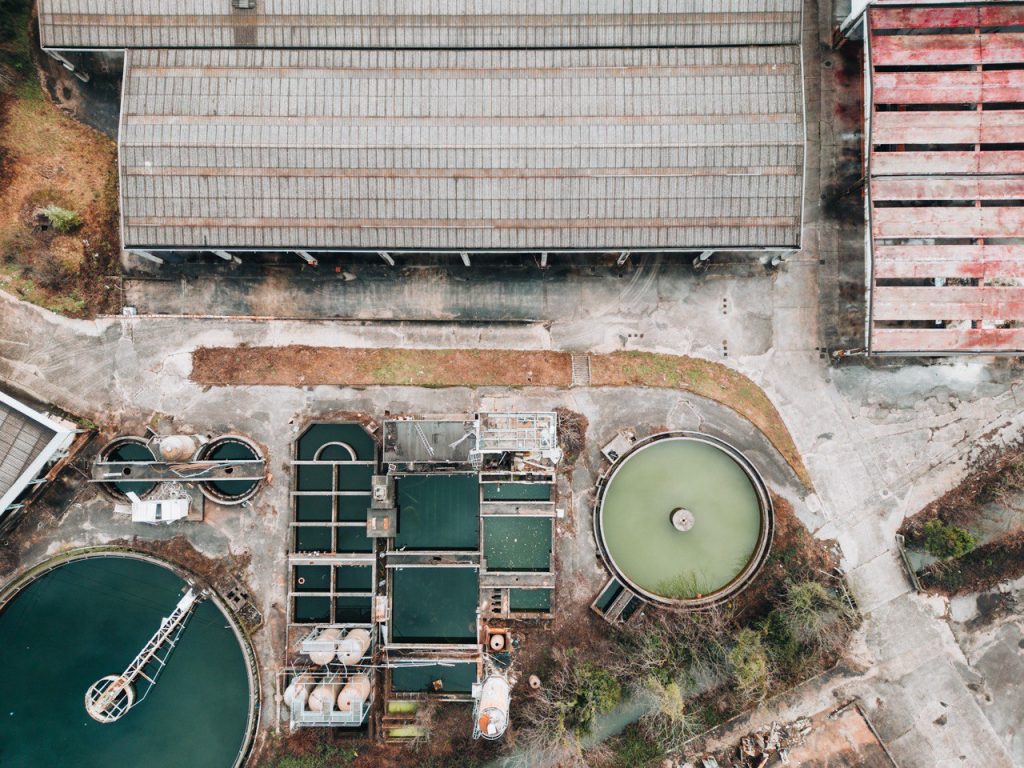
Starting from 1956 it grew gradually, both in surface and in revenue, diversifying its production from gray card and paper straw to paper bags and the usage of machinery for shredding. In that same period it got positioned in the entrepreneurial scene of Friuli, which was gradually emerging thanks to Camillo Malignani (son of Arturo Malignani, entrepreneur and investor of electric lightning) and the Association of the industrialists of Udine.
In this long and gradual path of growth, the urbanistic context has evolved, reaching, basically from scratch, a high intensity of housing settlements, which now surround the paper mill on two sides. The urban development of the sixties has by fact supplanted the original surrounding rural area, connecting in a more efficient way the industrial plant, which at that time was beginning to represent a social and economic opportunity for the entire area.
From the architectural point of view there is not much information on the composition of the Romanello paper mill. Anyway, every place has its anecdotes: inside the site flows the roggia of Udine, a small canal that runs through the area and has been fundamental for the industrial plant which has benefited from the water supply and hydric driving force.The canal splits the lot into two, referring to it as left bank paper mill, and open air raw material storage on the right bank. The expansion is almost entirely on the left bank of the roggia of Udine.
As of today, we do not know much of the history of the Romanello paper mill, except from the political and administrative matters that brought to the closing of the plant and the abandonment of the building, now under police custody.
The paper mill represents one of the many cases of abandonment of territories which got unproductive due to the crisis, being part of that desolation of industrial districts distinguished by dismissed warehouses. In this case, void is not an element of project design, but it is caused by the abandonment of the premises. It is difficult to map these territories: “The ratio between active and inactive warehouses is constantly evolving, many of them live intermittently (…) in a constant pursuit of a new image, able to reaffirm their presence in an agonizing context”.
“The warehouse can be seen as the piece of a complex puzzle, the puzzle of urban sprawl, where to set up a recycling action that does not run out of its power inside the boundaries, but contaminates the immediate surroundings, triggering regenerative processes in more extended spatial domains” Il declino della Terza Italia, by Luigi Coccia and Alessandro Gabbianelli in Riciclasi Capannoni, Recycle Italy, Rome, 2015
The paper mill represents today a further example of how the void, generated from the life cycle of architecture and its original functions, is an attractor of the physiological response of humans, which refuses the idea of leaving an uncontaminated space deprived of an apparent functional definition and with endless opportunities of use.
The subject of void and its occupation, contaminated and deprived of its anonymity, makes the Romanello paper mill an example of how space gets modified through art and is reborn with other functions and actors involved. It is the result of reappropriation, probably a generational matter that takes the opportunity to win back places that have lost their original meaning, signs of failed expectations formulated not too long ago.
Do you know of other places that have had a similar development? How many industrial or commercial mega-structures will go towards the same ending? Is there a solution to give them back meaning?